July 28, 2026
Loan Payment Calculator: The Complete Guide to Calculating Any Loan Payment in 2026
Search "loan calculator," "payment calculator," or "mtg calculator" (a common shorthand for mortgage calculator) and you'll find thousands of tools, all doing essentially the same math under the hood. Whether you're calculating a mortgage payment, a personal loan payment, or any other fixed-rate installment loan, the underlying formula never changes. Understanding it means you'll never be confused by a calculator's output again, and you'll know exactly which numbers actually move your payment up or down.
This guide breaks down the universal loan payment formula, walks through exactly how a mortgage payment calculator differs from a generic loan calculator, and shows you how to use amortization to your advantage no matter what you're financing.
The Universal Loan Payment Formula
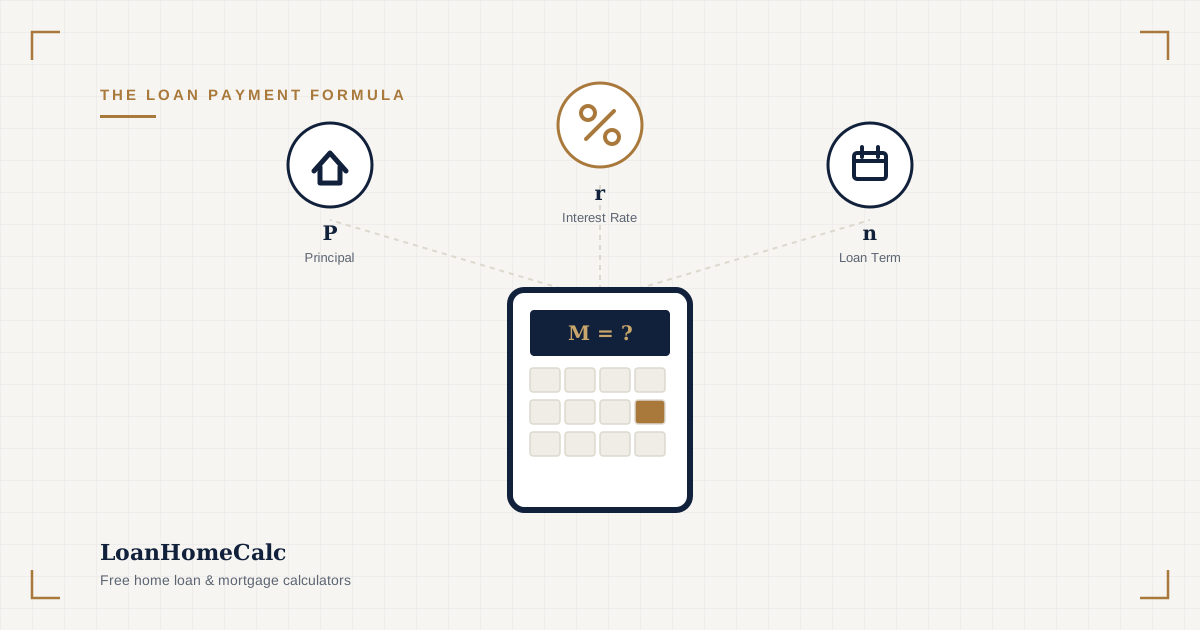
Every fixed-rate, fully amortizing loan, whether it's a 30-year mortgage or a 5-year personal loan, uses the same core formula to calculate the monthly payment:
M = P × [r(1+r)^n] / [(1+r)^n − 1]
Where:
- M = your monthly payment
- P = the loan principal (the amount borrowed)
- r = your monthly interest rate (annual rate divided by 12)
- n = the total number of monthly payments (loan term in years × 12)
It looks intimidating written out, but the intuition behind it is simple: your payment needs to be large enough that, spread across every month of the loan, it covers both the interest charged on your remaining balance and steadily pays down the principal until it hits zero at the very last payment.
What Three Inputs Actually Control Your Payment
Every loan payment calculator, no matter how it's branded, ultimately just needs three things from you:
1. Loan Amount (Principal)
This is simply how much you're borrowing. For a mortgage, that's your home price minus your down payment. For a personal loan, it's the full amount you're requesting.
2. Interest Rate
Even small rate differences compound significantly over a long loan term. On a $300,000 mortgage, moving from 6% to 7% adds roughly $200 to your monthly payment, over $70,000 across a 30-year term.
3. Loan Term
A longer term lowers your monthly payment but increases your total interest paid, since you're carrying a balance (and accruing interest on it) for more months. A shorter term does the opposite: higher monthly payment, lower total interest.
Mortgage Payment Calculator vs. a Generic Loan Calculator
Here's where a lot of confusion happens. A generic loan calculator or payment calculator typically only computes principal and interest (P&I) using the formula above. A dedicated mortgage payment calculator goes further, layering in the additional costs that come with owning a home:
| Cost Component | Generic Loan Calculator | Mortgage Calculator |
|---|---|---|
| Principal & Interest | ✓ | ✓ |
| Property Taxes | ✗ | ✓ |
| Homeowners Insurance | ✗ | ✓ |
| PMI (if under 20% down) | ✗ | ✓ |
| HOA Fees | ✗ | Optional |
This is exactly why two calculators can show you two very different "monthly payment" numbers for the same loan amount. If you're comparing a personal loan calculator's output to a mortgage calculator's output, you're not looking at the same thing; one is just P&I, the other is your full housing cost.
Our own Mortgage Calculator includes the full breakdown, principal, interest, taxes, insurance, and PMI, so the number you see is the number you'll actually pay each month, not just a partial estimate.
How Amortization Changes Your Payment Over Time
Even though your monthly payment stays fixed on a standard loan, how that payment is split between principal and interest changes dramatically over the loan's life. In the early years, most of each payment goes toward interest, since your balance, and therefore the interest charged on it, is at its highest. As you pay down the balance, more of each payment shifts toward principal.
This is called amortization, and it's the same mechanism whether you're six months into a mortgage or six months into a car loan. Our Amortization Calculator works for any fixed-rate, fully amortizing loan, not just mortgages, and generates a full year-by-year (or month-by-month) breakdown so you can see exactly how much of each future payment builds equity versus how much simply covers interest.
Personal Loans, Auto Loans, and Other Loan Types
If you're using a personal loan calculator, an auto loan calculator, or any other loan-specific tool, the math is identical to what's described above, just with different typical inputs. Personal loans and auto loans usually carry shorter terms (2-7 years) and don't include escrowed costs like taxes or insurance, since those aren't tied to a physical asset held as collateral the way a mortgage is.
The practical takeaway: you don't need a separate calculator for every loan type. Any tool built on the standard amortization formula, including ours, will give you an accurate principal and interest figure regardless of what you're financing.
EMI: The International Term for the Same Thing
If you've come across the term EMI (Equated Monthly Installment), that's simply the term used more commonly outside the U.S. for the same fixed monthly loan payment. There are actually two common ways to calculate it: the reducing-balance method, which is what nearly every U.S. mortgage lender uses and matches the formula above, and a flat-rate method that charges interest on the full original loan amount for the entire term, resulting in a notably higher effective payment.
Our Home Loan EMI Calculator lets you compute and directly compare both methods on the same loan amount, useful if you're evaluating loan terms that use flat-rate pricing.
Using Your Calculator to Plan an Early Payoff
Once you understand the formula, one of the most useful things you can do with it is model what happens when you pay more than the minimum. Because early payments are interest-heavy, extra principal paid early in a loan has an outsized effect on your total interest cost and payoff timeline compared to the same extra payment made later.
Our Mortgage Payoff Calculator lets you enter an extra monthly amount, a one-time lump sum, or a switch to biweekly payments, and see exactly how many years and how much interest you'd save.
Frequently Asked Questions
Is a mortgage calculator accurate?
A quality mortgage calculator is accurate for the principal, interest, tax, and insurance figures you input, but your actual rate, taxes, and insurance premium will be confirmed by a lender and local providers, so treat the output as a close estimate rather than a guaranteed final number.
What does "mtg calculator" mean?
"Mtg" is simply a common abbreviation for "mortgage," frequently used in search queries and by lenders in loan documents. A mtg calculator and a mortgage calculator are the same tool.
Can I use a mortgage calculator for a personal loan?
You can use the principal and interest portion of a mortgage calculator's output for a personal loan, but skip the tax, insurance, and PMI fields, since those don't apply outside of home financing. A general amortization calculator gives you a cleaner result for non-mortgage loans.
Why do two loan calculators give me different monthly payments for the same numbers?
This almost always comes down to what's included. One calculator may show principal and interest only, while another adds taxes, insurance, or PMI. Always check what's included before comparing two tools directly against each other.
Calculate Your Own Numbers
Now that you know what's happening behind the scenes, put it to use. Start with our Mortgage Calculator for a full monthly payment breakdown, or use the Amortization Calculator to see a complete payment schedule for any fixed-rate loan.